





SKKU Colleges of Computing and Arts Showcase Five Student Media Artworks at Ars Electronica 2026
- art
- Hit903
- 2026-09-21
SKKU Colleges of Computing and Arts Showcase Five Student Media Artworks at Ars Electronica 2026
- Works explore everyday life and rituals in the age of AI and data through an international collaborative course with the University of Arts Linz
- Joint exhibition, Disappearance of Rituals, brings together student works from the College of Computing and the College of Arts
Sungkyunkwan University’s College of Computing and College of Arts presented five student media art works at the Campus Exhibition of Ars Electronica Festival 2026, held in Linz, Austria, from September 9 to 13. The exhibition featured four works from the School of Global Convergence Studies in the College of Computing and one work from the College of Arts.
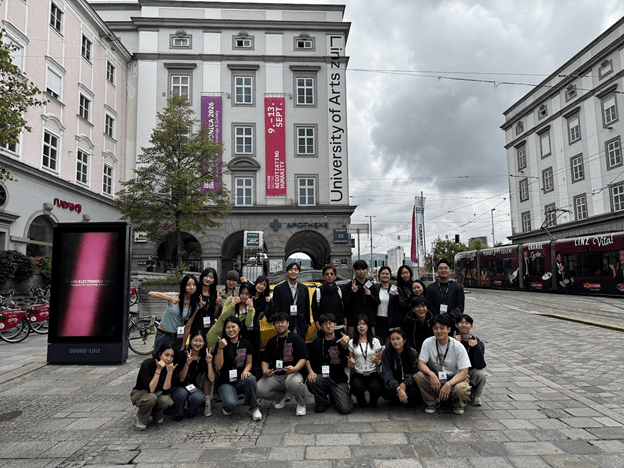
▲ SKKU students and faculty members participating in the Campus Exhibition at
Ars Electronica Festival 2026 pose in front of the University of Arts Linz in Austria.
Ars Electronica is an international festival that explores the intersection of art, technology and society. Its Campus Exhibition provides universities and educational institutions from around the world with a platform to present and exchange creative and research outcomes. This year, SKKU was selected as a partner university and presented its exhibition at the University of Arts Linz.
Titled Disappearance of Rituals, SKKU’s exhibition examined how AI and algorithms are reshaping everyday habits, emotions, relationships and meaning through interactive artworks. From the habitual act of scrolling through screens to the ways people express their wishes and seek comfort, the exhibition invited visitors to reflect on the rituals that are emerging—or disappearing—in the digital age.
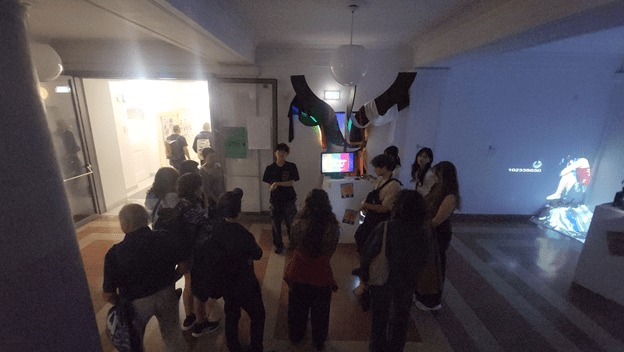 ▲ Visitors to SKKU’s Disappearance of Rituals exhibition listen to an explanation
of Baram in front of the installation.
The exhibition also marked an important step in connecting the creative work developed through an international collaborative course with an international art and technology festival. In the spring semester of 2026, the School of Global Convergence Studies in the College of Computing partnered with the University of Arts Linz through the WAVE program to offer Data Unfolded: Critical Interfaces and Material Practices.
The course was co-taught by Professor Lee Chang-jun, coordinator of the Culture and Technology Convergence major, and Professor Manuela Naveau of the University of Arts Linz. Students worked in teams to develop and produce artworks, incorporating critical investigations into data and interfaces as well as feedback and revisions throughout the process. Hess Jeon, a doctoral student at the University of Arts Linz, also served as a mentor and exhibition curator, helping connect the students’ creative development with the international exhibition.
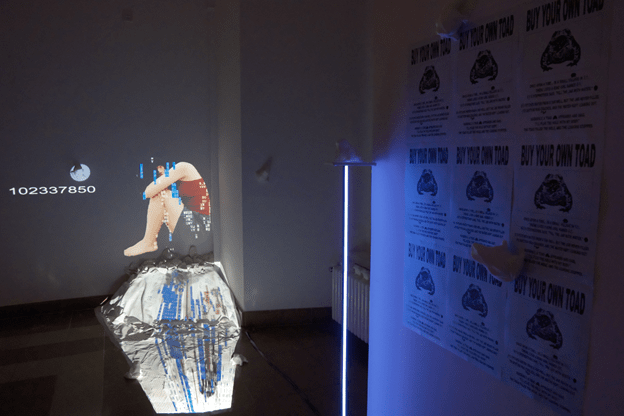
▲ www.buy-a-toad.com installation. Inspired by a Korean folktale about a toad that
plugs a hole in a broken jar, the work visualizes the paradox of purchasing
a digital toad to prevent data leaks only to expose even more data.
www.buy-a-toad.com, created by students Kim Gyu-won (Culture and Technology 24) and Kim Tae-rin (Culture and Technology 24), draws on a Korean folktale about a toad that stops water from leaking through a broken jar. The work poses questions about digital consumption and the collection of personal data by creating a paradox: the more visitors purchase a digital toad in an effort to prevent data leaks, the more data is ultimately released.

▲ Visitors experience Homo Eucalyptus, in which a koala image is superimposed on
their faces on screen. The work uses the koala’s ecology as a metaphor for people
who increasingly rely on AI for instant answers.
Homo Eucalyptus, by Yoo Ho-jin (Global Convergence Studies 19), Ahn Sae-byeol (Global Convergence Studies 23) and Lee Ye-seo (Global Convergence Studies 24), uses the ecology of the koala as a metaphor to explore whether humans who rely on AI for immediate answers may gradually lose their ability to investigate, question and discover things for themselves.
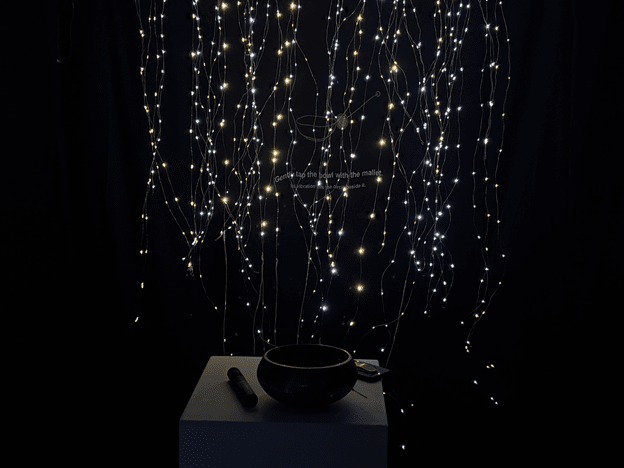
▲ Manifestation: Bloom from the Void installation. Using the sounds of
a singing bowl and light, the work creates a ritual-like experience
to explore self-reflection and agency in the age of algorithms.
Manifestation: Bloom from the Void, by Kim Si-yoon (Culture and Technology 22), Joo Seo-jin (Global Convergence Studies 24) and Lee Soo-min (Global Convergence Studies 24), explores self-reflection and personal agency in the age of algorithms through a ritual-like experience incorporating the sound of a singing bowl and light.
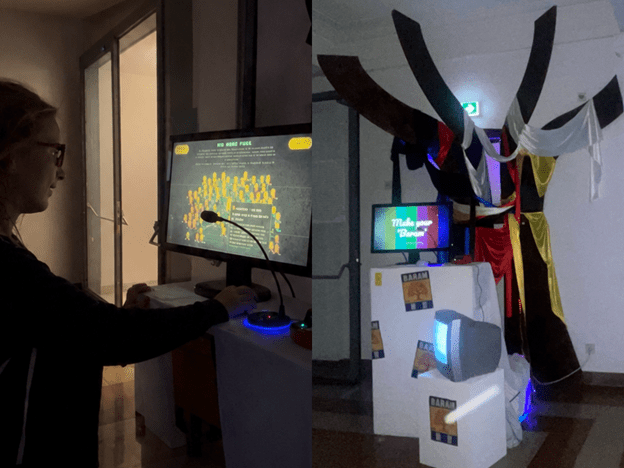
▲ Visitors interact with Baram. Drawing on the Korean word baram, which means both
“wish” and “wind,” the work transforms visitors’ voices into wind, light and sound to explore
whether technology can offer new ways of understanding and comforting people.
Baram, by Son Seung-jun (Culture and Technology 22), Park Ga-hyun (Global Convergence Studies 25) and Shin Ha-min (Global Convergence Studies 24), draws on the dual meaning of the Korean word baram, which refers both to a wish and to moving air. The work transforms visitors’ voices into wind, light and sound, asking whether technology can create new possibilities for understanding and comforting human beings.
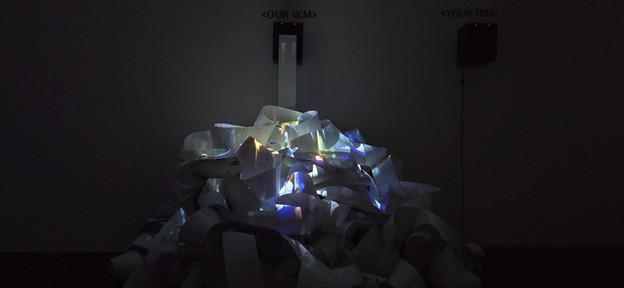
▲ 1KM; The Only Distance We Can Choose installation.
The work prints visitors’ scrolling through short-form content in the form of receipts,
turning the repeated act of digital consumption into a physical record.
1KM; The Only Distance We Can Choose, created by students Hwang Min-hyup (Film 19), Bae Joo-young (Global Convergence Studies/Film 22), Jung Ki-chan (Film 20), Choi Sung-yoon (Software/Film 18), Oh Se-ryeong (Film 22) and Hong Jun-seo (Film 25) of the College of Arts, transforms the familiar act of scrolling through short-form content into a physical record. Visitors’ scrolling is printed in the form of receipts, with the accumulating paper revealing the otherwise invisible distance of repetitive digital consumption.
The exhibition demonstrates an interdisciplinary approach to education that combines technical expertise in AI and data with critical inquiry in the humanities and social sciences and creative expression through art. By bringing together the College of Computing and the College of Arts, the program connected international collaborative education and student creativity with an international exhibition, demonstrating the potential of an educational model that crosses disciplinary and cultural boundaries.